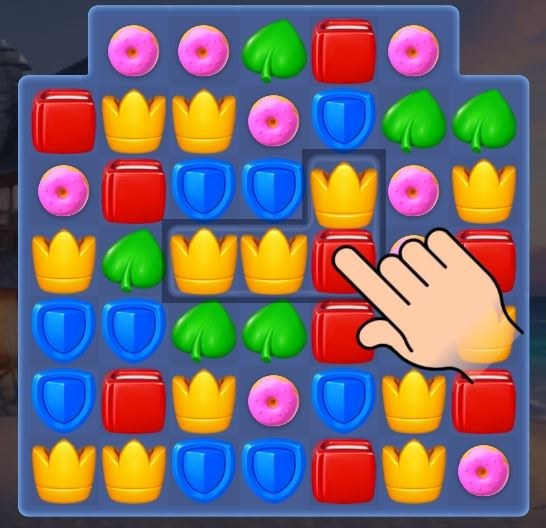
Buildingahouse is a calm, timer-free match-3 puzzle where you collect materials to construct a house, one room at a time. It suits players who enjoy methodical planning and a relaxed pace without aggressive monetization or flashy combos. Skip it if you crave competitive leaderboards, explosive chain reactions, or deep meta-progression.
What the First Minute Feels Like
You open Buildingahouse and there's no timer blinking at you. That's the first thing I noticed. The board sits there, a grid of colorful tiles—squares with wood grain, little brick patterns, roof shingle textures—and the game just waits. You can stare at it. You can plan a move for thirty seconds and nothing bad happens. I spent my first minute just matching three tiles near the bottom, watching them disappear, and seeing a small progress bar fill up a tiny bit on the side of the screen. There's no frantic countdown, no energy system nagging you to spend gems. It feels like someone handed you a puzzle and said "whenever you're ready."
The music, if you have sound on, is this quiet acoustic guitar loop that I forgot was playing after about two minutes. It's that kind of unobtrusive. The animations when you match tiles are soft—they sort of puff away rather than explode. Even the "level complete" pop-up floats in gently instead of slamming the screen. I know that sounds like small stuff, but in a genre that's usually trying to amp you up with sparkles and combo screams, this restraint stands out.
How the Loop Actually Works
If you've played any match-3 game in the last decade, the basics are second nature: swap two adjacent tiles to line up three or more of the same type, they vanish, new tiles fall in from the top. But Buildingahouse isn't about reaching a target score or clearing jelly layers. Instead, each level asks you to collect specific materials—wood, brick, tile, glass—by matching the corresponding tiles. You need, say, 15 wood and 10 brick to "complete" the current construction phase, and that fills a house blueprint incrementally.
The strategy layer comes from how you prioritize. You can see the full material requirements at the start of the level, and here's the thing: the board doesn't always give you what you need. You might need 12 glass tiles, but the board spawns them sparingly. So you start making choices. Do you burn moves clearing wood tiles you don't need, just to cycle the board and hope glass drops? Or do you set up a four-match on some brick you'll need later, even though it's not your immediate bottleneck? That's the optimization puzzle. The game rewards efficiency—finishing with leftover moves gives you bonus points that go toward a separate "crafting" currency, but honestly, the real reward is the unhurried satisfaction of a clean run.
There's also a mild combo system. Matching five tiles in an L-shape creates a "blueprint" tile that, when matched, acts as a wildcard and collects two random materials from the current requirements. Matching four in a row gives you a row-clear tile. These feel nice but they're not overpowered. I found myself using them more to fix a clogged board than to chase big scores. The game doesn't push you to be flashy.
What You're Actually Optimizing For
Once you settle into the rhythm, you realize the real metric isn't stars or points—it's move economy. Every level has a par number of moves, and finishing under par is where the quiet thrill lives. It's not advertised anywhere with a big shiny badge, but the game tracks it, and you'll notice yourself glancing at the move counter and thinking "I can do this in 18 instead of 22."
I started making little rules for myself. Never match three if a four-match is available and won't cost me two extra moves to set up. Always check the top of the board before making a low match, because a cascade might solve your problem for free. If I'm one material short of the goal and it's sitting right there in an obvious pair, don't get cute—just take it. The game's relaxed pace means you have time to scan, and scanning becomes the skill. You develop a rhythm: check requirements, scan the board top to bottom, identify the scarcest material, and work from the bottom up to maximize cascade potential.
The house-building theme helps here. Each level adds a room or a floor, and you can see the structure growing on a static screen between levels. It's not a deep customization system—you can't pick paint colors or furniture—but it gives a sense of progression that pure abstract puzzle grids lack. By level 20 or so, you've got a modest little house with a roof and windows, and that feels surprisingly grounding.
Mistakes That End Runs Early
Even without a timer, you can paint yourself into a corner. Here are the concrete ways I messed up in my first session:
Tunnel vision on one material. Early on, I'd spot that I needed 8 wood and just match wood tiles relentlessly, ignoring everything else. What happens is you clear all the wood, the board fills with brick and glass you don't need yet, and suddenly you have no wood spawning because the drop RNG is clogged. You end up wasting three or four moves just clearing junk to cycle the board, and your move count balloons. The fix is to spread your matches across material types, even ones you don't urgently need, to keep the board fluid.
Ignoring the bottom rows. There's a natural instinct to match wherever you see an easy three, which is often near the top where new tiles drop. But matching low gives you cascades—tiles fall further, chain reactions happen, and you collect materials without spending extra moves. I lost a level by two moves once, and reviewing my play, I'd made six matches in the top two rows that could have been low matches for the same result plus a cascade.
Hoarding power tiles. Those blueprint wildcards feel precious, so I'd save them. Then I'd reach the last three moves, finally use one, and it would give me materials I'd already collected enough of. The lesson: use them mid-level when the board state is still flexible, not as a desperate last resort. They're more valuable for board-clearing than for collection.
Not checking the full requirement list. Some levels have a second phase. You finish collecting the initial batch of materials, and then the game says "great, now collect 8 more glass and 6 brick for the chimney." If you burned all your glass tiles in phase one because you didn't scroll the requirement list, you're starting phase two with a board full of wood and no way to generate glass quickly. Read the whole list before your first move.
Phone vs Desktop: What I Noticed
I played on both my laptop and my phone, and there's a difference worth mentioning. On desktop, the wider screen gives you a slightly more panoramic view of the board. You can see all columns without scrolling, and mouse clicks feel precise. I found myself spotting four-match setups faster because my eye could take in the whole grid at once.
On mobile, the board fills the screen nicely in portrait mode, and the touch controls are responsive—no lag, no accidental swaps. But the narrower view means you might need to scroll vertically on some larger boards, and that tiny extra friction made me slightly less efficient. I'd miss a potential match in the top row because I hadn't scrolled up yet. It's not a dealbreaker, but if you're the type who really cares about optimizing move counts, desktop gives you a small edge. The game runs fine in a browser on both, no downloads needed, which is nice when you just want to open a tab and play.
Who Should Bother, and Who Should Skip
This game is for you if your favorite part of match-3 puzzles is the calm, methodical planning phase—that moment before you make a move when you're scanning the board and mapping out possibilities. If you find Candy Crush too frantic with its timers and limited lives, or if you bounce off games that gate progress behind aggressive monetization, Buildingahouse feels like a deep breath. It's also good if you want a puzzle game you can play for ten minutes during lunch without getting adrenaline spikes.
You should probably skip it if you crave high-score chases, competitive leaderboards, or the dopamine hit of explosive chain reactions that clear half the board. The combos here are modest. There's no versus mode, no daily tournaments. If you need a game to constantly tell you you're amazing with flashing text and particle effects, this will feel too quiet. Similarly, if you want deep meta-progression—leveling up characters, unlocking story chapters, collecting dozens of power-up types—this isn't that. The house-building is charming but thin. It's a thematic wrapper, not a sim game.
Also, if you're the type who gets bored without escalating difficulty spikes, know that the challenge here increases very gradually. By level 30, I was still using the same core strategies; the boards just got a little larger and the material requirements a little tighter. That's the point, really—it's a comfort game. But comfort isn't for everyone.
A Practical 10-Minute Practice Plan
If you want to get better quickly without grinding, here's a focused routine I worked out after about an hour of play. Set aside ten minutes and do this:
Minutes 1–3: Board scanning drill. Open any level and don't make a single move for 60 seconds. Just look. Identify every possible four-match on the board. Then find every possible five-match L-shape. Then count which material type is rarest based on the current board state. Do this without touching anything. It trains your eye to see patterns without the pressure of acting on them.
Minutes 4–6: Bottom-row only challenge. Start a level and restrict yourself to only making matches where at least one tile is in the bottom two rows. If no such match exists, you can make one move above to set one up, but then immediately go back to the bottom. This forces cascade thinking and prevents the lazy top-match habit. You'll probably lose or finish inefficiently the first time, but the lesson sticks.
Minutes 7–9: Requirement-first planning. Before your first move on a new level, write down or mentally note the full material list. Then scan the board and count how many of each material you can collect with straightforward three-matches right now. If one material is already scarce, make a plan for how to cycle the board to generate more. Play the level with the sole goal of never being surprised by a phase-two requirement.
Minute 10: Review one loss. If you have a level you failed, replay it and watch your own habits. Did you ignore a four-match setup? Did you tunnel on one material? Did you hold a power tile too long? Identify one specific mistake, not a vague "I was too slow," and name it. Next level, guard against that one thing.
That's it. Ten minutes, no grinding, just deliberate practice. Do that a few times and the game's rhythms will start to feel intuitive. You'll catch yourself making better choices without overthinking.
Buildingahouse isn't trying to be the most innovative match-3 game out there. What it does is strip away the noise—the timers, the aggressive upsells, the sensory overload—and leave you with a clean, quiet puzzle that respects your time. For a free browser game you can play without installing anything, that's rarer than it should be. Give it a few levels to settle in. The house grows on you. Literally.