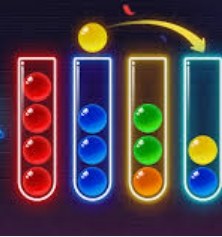
Ball Sort Master is a calm, methodical sorting puzzle where you stack colored balls into matching tubes using limited empty space. It suits patient planners who enjoy optimizing moves and avoiding dead ends without timers or flashy extras.
I opened Ball Sort Master expecting the usual pastel-tubes-and-bubbles routine. The first minute actually caught me off guard. You get two empty tubes and a mess of colored layers stacked in ways that look almost reasonable until you try your third move and realize you've already painted yourself into a corner. That quiet moment where you stare at the screen, undo your last three taps, and start over? That's the game.
The Loop That Keeps You Tapping
Ball Sort Master is a straightforward sorting puzzle. You've got a handful of glass tubes, some empty, most filled with mixed layers of colored balls. Tapping a tube lifts the top ball, tapping another drops it in — but only if the destination tube is empty or the top ball already matches your color. The goal is to consolidate every color into its own tube. No timers, no scores, no power-ups. Just you and increasingly tangled stacks.
What you're actually optimizing for isn't speed. It's move economy and dead-end avoidance. Every time you relocate a ball to a temporary holding tube, you're spending a resource: empty tube space. Run out of empties and you lose your ability to shuffle. The game doesn't punish you with a big "game over" screen. It just quietly makes your current layout unsolvable, which is somehow worse. You'll sit there cycling through the same three moves until you accept that the undo button can only take you back so far.
The difficulty curve ramps by adding more colors and more tubes. Early puzzles give you four colors across five tubes with two empties. Later stages push seven or eight colors, and those two empties start feeling like one and a half. The puzzle design is tight enough that I rarely felt cheated — just outsmarted by my own impatience.
Which Moves Actually Pay Off
After about an hour of play spread across a few days, I started noticing patterns in what separates a clean solve from a restart. The highest-value move in Ball Sort Master isn't completing a color. It's creating a new empty tube. When you finish consolidating one color into a full tube, you free up whatever tube was holding the last straggler balls. That new empty is oxygen. Every good sequence I pulled off started with me identifying which color was closest to completion and aggressively prioritizing its consolidation — even if it meant temporarily making other tubes messier.
Second best move: partial stacking with intent. If you've got three red balls scattered across different tubes but one tube already has two reds at the top, don't just dump every red you find into it. Check whether the reds below the surface are blocked by colors you can't easily relocate. I burned myself multiple times by filling a tube with four matching balls on top, only to realize the bottom layer was a different color completely trapped underneath. That tube becomes a dead zone until you solve that buried color, and if that buried color appears nowhere else near the surface, you're stuck.
The move that almost never pays off? Spreading balls out "just in case." If you have a yellow ball sitting on top of a blue stack and you move it to an empty tube without a plan for where the next yellow will come from, you've just converted your most flexible resource — an empty tube — into a single-purpose holding cell. I did this constantly in my first ten puzzles. It feels safe. It's actually the fastest route to gridlock.
Mistakes That End Runs Early
The biggest run-ender is ignoring what's beneath the surface. You'll fixate on matching the visible top balls and forget that three moves from now, you'll expose a color you have nowhere to put. I started doing a quick scan every few moves: for each tube, what's the second ball down? If I can't answer that, I slow down.
Another trap: refusing to undo. The undo button isn't a shame button. Some puzzles have a narrow solve path, and your first instinct might be wrong. I found that if I hit a point where I was making moves just to make moves, undoing back four or five steps and trying a different branch almost always broke the logjam. The game doesn't limit undos, which is generous, but it also means you can undo yourself into a loop of bad decisions if you're not careful.
Overvaluing a "clean" tube is a subtler mistake. You finish one color and suddenly you've got a pristine tube of all greens. It's tempting to treat that tube as sacred and never touch it again. But sometimes the optimal play is to temporarily break a completed tube apart to free up space elsewhere. It feels wrong. It's often right. I resisted this for ages and it cost me solves on the harder puzzles where every empty matters.
Phone vs Desktop: It Matters Here
I played on both my phone and a desktop browser. The game runs identically — it's a simple HTML5 setup, no installs, no account required. But the experience is noticeably better on mobile. Tapping tubes with your thumb is fast and tactile. On desktop, clicking with a mouse feels slightly slower and less precise, especially when you're trying to chain moves quickly. There's no drag-and-drop; it's all tap-to-select, tap-to-place. That interaction model was clearly designed for a touchscreen first.
One practical note: on a smaller phone screen, tubes with five or six balls can get visually cramped. I misread colors a couple of times when similar shades (orange vs red, dark blue vs purple) sat next to each other in adjacent tubes. Not a dealbreaker, but worth knowing if your eyesight isn't sharp or you're playing in bad lighting. Desktop solves that problem with a bigger display, at the cost of that snappy tapping rhythm.
Who Should Bother, Who Should Skip
If you like puzzles that reward planning ahead — the kind where you stare at a layout for thirty seconds before touching anything — Ball Sort Master will click. It scratches the same itch as organizing a messy drawer or untangling holiday lights. There's no time pressure, no ads between every puzzle (at least in the version I tested), and the satisfaction of watching a chaotic spread resolve into neat color-coded tubes is genuine.
If you need narrative, progression systems, or any kind of feedback beyond "you did it," this isn't your game. There's no leveling up, no unlockable tube skins, no story. It's one puzzle after another, and the only thing that changes is the complexity of the sorting. Some players will find that meditative. Others will find it monotonous by puzzle twenty. I'd say it's ideal for short sessions: waiting for coffee, killing ten minutes before a meeting, unwinding before bed. Not a game I'd marathon, but one I keep coming back to in gaps.
Also worth mentioning: if you have color vision deficiency, proceed with caution. The game relies entirely on color differentiation, and while the balls have slight size and shading differences, I didn't see any colorblind mode or pattern overlays. A few color pairs (blue/purple, orange/yellow) got muddy for me even with typical vision in low brightness.
A Practical 10-Minute Practice Plan
If you want to get sharper at Ball Sort Master without grinding through endless puzzles, here's a focused ten-minute drill I used to stop making the same dumb mistakes. I'd run this as a warm-up or after a frustrating loss.
Minutes 0–2: Empty Tube Audit
Start a new puzzle and don't make a single move. Count your empty tubes. Now count how many colors are currently "surface accessible" — meaning a ball of that color is visible on top of at least one tube, with no conflicting colors blocking it from being moved to an empty or matching tube. If surface-accessible colors outnumber your empty tubes by more than one, you're already in a tight spot. This audit takes sixty seconds and trains you to see the board state rather than react to it.
Minutes 2–5: The Consolidation Sprint
Pick the color that appears most frequently in the top two positions across all tubes. Spend three minutes doing nothing but moving balls of that color together, even if it means temporarily parking non-matching balls in awkward spots. The goal isn't to solve the puzzle. It's to see how close you can get to completing one color. At the three-minute mark, stop. Did you create a new empty tube? If not, rewind and try a different color. This drill teaches you to identify which color is actually closest to completion, not which one looks most satisfying to tidy up.
Minutes 5–8: The Bad Move Experiment
Deliberately make a move you suspect is bad. Move a singleton ball into your only empty tube. Watch what happens over the next ten to fifteen moves. How quickly does your flexibility collapse? When do you first feel stuck? This is uncomfortable but it's the fastest way to internalize why empty tube conservation matters. You'll start recognizing the early warning signs of a dying board — usually when you have more than two tubes that are "locked" with mismatched layers and no easy way to peel them apart.
Minutes 8–10: Undo Discipline
For the last two minutes, set a rule: you can only undo three times. Pick a puzzle you haven't solved before and try to complete it with that constraint. This forces you to commit to branches and live with suboptimal placements. It's stressful in a good way. You'll notice which types of mistakes you keep wanting to undo — those are your patterns. For me, it was jumping the gun on moving a ball to an empty tube before I'd confirmed there were more of that color accessible nearby.
I ran this plan four times across different puzzles and it genuinely changed how I approached harder layouts. I stopped panic-tapping and started seeing two or three moves ahead. The game didn't get easier, but I got faster at recognizing dead-end shapes before I walked into them.
Ball Sort Master isn't flashy. It's a quiet, compact puzzle that respects your time and doesn't beg for attention. The combo of careful planning and the occasional bold undo is where the real satisfaction lives. If you're the type who likes to figure out systems and optimize them silently, you'll find a lot to chew on here. Play it free in your browser, keep an eye on those buried balls, and for the love of tidy tubes, stop putting singletons in your empties.