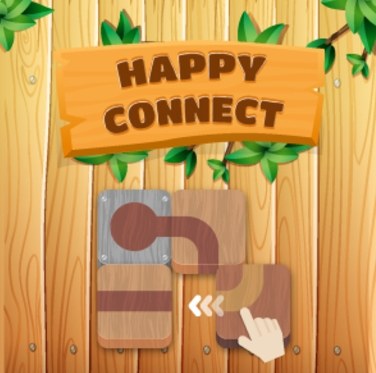
Happy Connect is a fast-paced match-and-link puzzle where you draw paths between identical tiles to build combos before the board locks up. It suits players who enjoy quick pattern recognition and rising tension, but not those who want deep strategy or relaxed pacing.
What the First Minute Feels Like
You open Happy Connect and it looks almost deceptively simple. A grid of cheerful little faces, fruits, or animals stares back at you — the exact tiles depend on the theme it loads, but they're always round and slightly bouncy. You tap one, drag to an identical neighbor, and they link with a thin, satisfying line. The first few connections feel like busywork. You're clearing four, five, maybe six tiles at a time and watching your score tick up in tiny increments. It's pleasant, but you're not sure where the challenge is hiding.
Then you hit your first board with a locked tile in the corner, or a timer that suddenly appears without warning, and the whole mood shifts. That gentle "connect the matching things" game now has teeth. You realize you've been casually burning through easy links while the board was quietly running out of viable pairs. I spent my first three games just connecting whatever I saw, and all three ended before I hit 1,000 points. The game doesn't explain what you're doing wrong — it just lets you fail and restart, which is honestly the right call for this kind of puzzle.
How the Loop Actually Works
Happy Connect belongs to the match-and-clear genre, but it's not a match-three. You're drawing paths between identical tiles, and the path can bend at right angles as long as it doesn't cross other tiles. The core loop is: scan the board, identify pairs, connect them before the board stagnates, and manage whatever special conditions the current level throws at you. What you're really optimizing for is combo chains — linking multiple pairs in rapid succession without long pauses. The game tracks this silently, and your score multiplier builds the faster you go.
Most levels give you a target score or ask you to clear a certain percentage of the board. The catch is that tiles shuffle or new ones drop in unpredictably. You can't plan more than two or three moves ahead with real confidence. This forces you into a rhythm of quick scanning and instinctive linking, which is where the combo system starts to matter. A single pair clears slowly and gives you base points. Three pairs linked within about two seconds of each other? That's a combo, and the point jump is noticeable. Five or more, and the multiplier turns a mediocre run into a high-score run.
You'll also notice the board has a "heat" to it. When you're clearing tiles fast, the remaining pieces seem to arrange themselves more favorably. When you hesitate and hunt for perfect connections, the board tightens up and you start seeing dead ends. I can't prove the algorithm nudges things, but after 20 minutes of play, it absolutely feels like momentum matters.
What Actually Counts as a High-Value Move
Not all connections are equal, and the game penalizes you for treating them like they are. A high-value move in Happy Connect isn't just about clearing tiles — it's about clearing tiles that unlock new pairs. You want to target clusters where three or more identical tiles sit adjacent or in a clean L-shape. Those configurations let you chain two or three connections almost instantly because the path is already half-formed in your head before you even swipe.
The other high-value pattern is what I started calling "bridge pairs." These are two matching tiles that sit on opposite sides of a clogged section of the board. Connecting them requires a path that snakes around obstacles, and the game rewards longer paths with a slight score bump. More importantly, removing those two tiles often collapses the board in a way that reveals three or four easy pairs underneath. You're not just scoring points — you're engineering the next ten seconds of play.
Special tiles complicate this. Some levels include tiles that need to be matched twice, or frozen tiles that require an adjacent match to thaw before they become usable. Ignoring these until the end is a trap. The game baits you into clearing the easy stuff first, and then you're left with two frozen tiles on opposite corners and no way to reach them. High-value play means integrating those problem children into your combos early, even if it means taking a slightly slower connection to thaw something or double-tap a stubborn tile while you still have board flexibility.
Mistakes That End Runs Early
The most common run-killer is tunnel vision. You spot a pair, you connect it, you feel good, and you immediately look for the next pair of the same type without scanning the whole board. This burns time and leaves other tile types piling up in corners where they becomes un-matchable. I lost at least four runs this way before I forced myself to switch tile types every two or three connections. The game punishes monogamous matching hard.
Another mistake: ignoring the edges. Tiles along the border of the board have fewer neighbors, which makes them harder to match once the center clears out. If you see a border pair available, take it sooner rather than later. Waiting until the board is half-empty and hoping that edge tile will still have a friend within reach is pure gambling, and the house usually wins.
Overthinking paths is the third big one. The line-drawing mechanic is surprisingly forgiving about angles, but players (myself included) tend to redraw the same path mentally three times before committing. That hesitation kills your combo timer. The game wants confident, slightly reckless play. If the path looks even 80% viable, swipe it. A failed connection just bounces back and costs you maybe a second. A paused combo chain costs you the entire multiplier and often the run.
Lastly, don't hoard power-ups if the game gives you any. Some versions of this genre include a shuffle or a hint button, and players treat them like emergency rations. Use them when the board has three or four obvious pairs left and you want to chain into the next shuffle cleanly. Waiting until you have zero moves is too late — the power-up often can't save a fully dead board.
Phone vs Desktop: It Matters More Than You'd Think
I played Happy Connect on both a mid-range Android phone and a desktop browser with a mouse, and they're almost different experiences. On phone, the drag-and-release feels fast and tactile. Your finger covers less of the screen than you'd expect, and you can chain combos with a kind of muscle memory that kicks in after a few rounds. The downside is that on smaller screens, tile distinctions get muddy. If the game loads a theme with similar colors — say, a peach and an orange fruit — you'll mis-tap and break your combo at least once per session.
On desktop, the mouse gives you precision. You see the whole board at once without scrolling, and you can hover over tiles to double-check matches before clicking. The trade-off is speed. Click-drag-release with a mouse is physically slower than a finger swipe, and I found my combo counts dropped by about 20% on desktop even though my accuracy improved. If you're chasing high scores, phone is the way to go. If you're learning the game's patterns and want to study board layouts without pressure, desktop is a gentler entry point. The game runs fine in any modern browser, no install needed, which makes it easy to test both and see which feels right.
Who Should Bother, Who Should Skip
Happy Connect is built for people who like their puzzle games with a pulse. If you enjoy the early-game calm of something like Candy Crush but wish the difficulty ramped faster and depended less on luck, this will click. The combo system rewards pattern recognition and quick decision-making, not just patience. It's also a solid choice if you have short gaps of time — a full run rarely lasts more than five minutes unless you're exceptionally good, so it fits into coffee breaks without overstaying its welcome.
Skip this if you want deep strategy or elaborate progression systems. There's no story, no character upgrades, no meta-game currency to manage (at least in the version I played). What you see is what you get: a clean, increasingly tense matching game that resets cleanly each time. If you need a sense of building toward something over weeks, this isn't it. Also skip if fast visual scanning stresses you out. The timer variants in particular punish anyone who needs a few seconds to orient. I have a friend who hates timed puzzles, and I wouldn't recommend this to him at all.
It's worth mentioning that the game is free in browser, so the barrier to trying it is basically zero. You'll know within three runs whether the rhythm works for you or makes you want to close the tab.
A Practical 10-Minute Practice Plan
If you want to get decent at Happy Connect without grinding aimlessly, here's a focused 10-minute drill I used to stop dying at 800 points and start hitting 3,000-plus consistently.
Minutes 0–2: Slow scanning only. Don't connect anything yet. Just look at the board and mentally tag every pair you see. Count them. This builds the habit of wide visual sweeps instead of locking onto the first match. Do this for two full minutes across multiple boards if you restart quickly.
Minutes 2–5: Speed runs with no combo pressure. Now connect as fast as you physically can, ignoring combos entirely. The goal is to clear the board or die trying, just to see how quickly your fingers can execute without your brain second-guessing. You'll fail a lot here, and that's fine. You're building the motor pathway.
Minutes 5–8: Combo focus. Slow back down slightly and aim for chains of three or more. Prioritize connections that sit near each other on the board, even if they're not the most "obvious" pair. If you drop the combo, don't restart — just start a new chain. The goal is to feel what a sustained multiplier rhythm feels like.
Minutes 8–10: One real run. Take everything from the previous drills and play a single serious attempt. No restarts, no quitting early. See where you land. Pay attention to where the run fell apart — was it a border tile you ignored? A frozen tile you left too long? Knowing your specific failure mode matters more than chasing a number.
Repeat this plan across a few days and you'll notice your baseline score climbing without feeling like you're grinding. The game rewards trained instincts more than memorized patterns, and ten focused minutes beats an hour of distracted play every time.