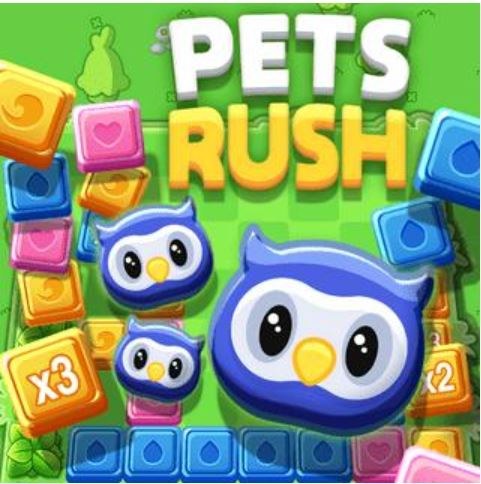
The Pets Rush is a spatial puzzle game disguised as a cute pet-saver, where you strategically detonate blocks to keep animals from falling off a crumbling board. It suits players who enjoy resource-management challenges with real consequences, where every tap can trigger chain reactions that either save or doom your run. Skip it if you hate timers, need explicit tutorials, or expect a casual collecting experience—this game teaches through failure and won't comfort you when pets tumble into the void.
I loaded up The Pets Rush expecting something gentle. The name, the thumbnail with fluffy cartoon faces—I figured I'd be matching treats or maybe solving light puzzles. Then the first bomb went off and a pixel-art bunny flew across the grid. Not hurt, just... relocated. That's when I realized this is a bomb-blast game wearing a pet-sitting hat.
The first minute is pure information overload in the best way. You're dropped onto a board filled with colored blocks, and nestled among them are little animals—cats, dogs, a hamster that looks perpetually startled. A timer's ticking. You tap a block, it explodes, and the shockwave clears everything in a small cross pattern. The pets tumble toward the bottom. If they land safely on remaining blocks, you keep going. If the floor under them is gone and they keep falling, the run ends. The tutorial barely exists, which I honestly prefer. You learn by accidentally launching a corgi into the void.
What surprised me was how quickly my brain switched from "aww cute" to frantic spatial calculation. The game doesn't care about your feelings. It hands you a limited number of taps per level, a board that's slowly crumbling from the bottom up, and pets that keep arriving faster than you can clear space for them.
What you're actually optimizing for
At first glance The Pets Rush looks like a match game, but you're not matching anything. You're doing controlled demolition. Every tap removes a block and anything adjacent in the four cardinal directions. The goal isn't to clear the board—it's to keep at least one block under each pet as the screen scrolls upward. Pets don't move on their own, but gravity is constantly pulling them down through gaps you create.
The loop settles into a rhythm after a few runs. You scan the board for stacked blocks that can act as temporary platforms. You notice which pets are dangling over empty space. You start to value blocks not for their color or position relative to other blocks, but for their structural role. A single block in the middle of nowhere might be the only thing keeping three animals alive. Blow it up and you've got a triple failure in half a second.
Points accumulate based on how many pets survive each wave, with multipliers kicking in when you clear large groups of blocks in one blast. But chasing the multiplier is what killed my first six runs. I'd spot a juicy cluster of same-colored blocks, tap it, and suddenly realize I'd just removed the floor from under a sleeping kitten. The game doesn't warn you. It just shows a sad animation and docks your score.
The subtle genius is that block colors do matter, just not in the match-three way you'd assume. Same-colored blocks that are touching will chain-explode when one is tapped. This lets you clear big sections efficiently, but the chain reaction is unpredictable if you haven't mapped it in your head first. I lost a promising run because a chain I triggered three columns away wrapped around and took out a critical support block I'd been saving. The blast radius isn't shown as a preview, so you develop a kind of internal sonar for it after a while.
The mistakes that end runs early
My first dozen attempts died to the same three errors, and I watched my partner make all of them too when I handed her the phone. Here's what actually kills you:
Tapping the bottom row without checking above it. The board scrolls upward as blocks disappear from the bottom. If you clear a bottom-row block that has pets sitting two or three rows higher with nothing underneath, they fall straight through. I started forcing myself to scan the entire column before touching anything in the lowest visible row. Feels slow at first, but it saves runs.
Trusting chain reactions. When same-colored blocks are adjacent, one tap blows them all. The problem is you can't control the order of the chain. If the explosion propagates left before it goes up, it might clear a side support you were relying on. I now treat chains as a last resort when I have surplus taps, rather than my main strategy.
Forgetting that new pets arrive mid-wave. The game spawns additional animals as the timer ticks down, and they always appear at the top. If you've already cleared the upper blocks to create a "safe zone" lower down, the newcomers have nothing to land on. You need to leave some scaffolding near the top or be ready to blast a platform into existence quickly. I started reserving at least one tap specifically for emergency pet-catching.
Playing too fast after wave five. The first few waves are forgiving—few pets, lots of blocks, generous timer. Around wave five the pet density spikes and the available blocks thin out. My instinct was to speed up to match the pressure, but faster tapping just meant sloppier structural decisions. The players who score highest seem to be the ones who slow down slightly when the board gets crowded, taking an extra half-second to trace fall paths before committing.
Phone versus desktop: it matters here
I tested The Pets Rush on both a mid-range Android phone and a laptop browser with a trackpad, and the experience splits pretty hard.
On phone, the touch controls feel native. You're tapping directly on blocks, and the haptic feedback (if your browser supports it) gives a satisfying little thunk on each detonation. The vertical portrait layout means you see more rows above than to the sides, which actually helps with the bottom-up scrolling mechanic. The downside is that my thumb occasionally obscured a pet in the lower-left corner, and I tapped a block I shouldn't have because I literally couldn't see the animal sitting on it. I started tilting the phone slightly to check blind spots. Not ideal, but manageable.
On desktop with a mouse, precision goes way up. You can hover over a block and see the full column clearly before clicking. The screen is wider, so peripheral vision catches pets near the edges more easily. The trade-off is speed. Clicking is slower than tapping, especially when you need to detonate three blocks in quick succession to create a cascade platform. I found myself gravitating toward the phone version for serious score-chasing, but using desktop when I wanted to study board layouts and practice reading chain-reaction paths without the time pressure.
There's no official app, just the browser version, which means you're at the mercy of your mobile browser's performance. On Chrome it ran smoothly. On an older tablet with a stock browser, I got stuttering during chain reactions that made the timing feel off. If you're serious about high scores, test it on whatever device gives you the smoothest frame rate, because a stutter during a four-block chain can mean the difference between catching a falling pet and missing it entirely.
Who should bother, and who should absolutely skip
The Pets Rush is not for everyone, and the cute aesthetic is going to attract exactly the wrong audience if they don't read past the title. Here's my honest take after spending an evening with it.
You'll enjoy it if: you like games that look simple but punish you for treating them that way. If you've ever gotten hooked on a "one more try" loop where failure teaches you something specific each time, this scratches that itch. The skill ceiling is real—I kept discovering new techniques around wave eight that made me rethink how I'd played the first seven. People who enjoy resource-management puzzles where every action has a spatial consequence will find a lot to dig into. There's also a meditative quality to the mid-game once you stop panicking and start reading the board like a map.
You should skip it if: you hate timers. The countdown is not cosmetic; it ends runs. If time pressure makes you anxious rather than focused, this game will just stress you out. Also skip if you want a casual pet-collecting experience. You do not collect pets. You do not name them. They are adorable physics objects that fall into the abyss when you mess up, and the game does not comfort you about it. I'd also warn off anyone who needs explicit tutorials. The game teaches through failure, and the first few runs will feel unfair until you internalize the rules. If you're the type to uninstall after dying twice without understanding why, The Pets Rush won't hold your hand.
Kids and younger players: mixed bag. The visuals scream "children's game," and my seven-year-old niece was immediately drawn to the animals. But the strategic layer is genuinely demanding. She had fun for about three waves, then got frustrated when her tapping didn't produce the results she expected. I'd say ten and up, and even then only if the kid enjoys puzzle games rather than purely reactive ones. For adults looking for a focused 15-minute brain workout during a break, it's near perfect. The free browser format means no install friction, which lowers the barrier to just trying it and seeing if the loop clicks.
A 10-minute practice plan that actually builds skill
I spent my first hour just throwing myself at runs and hoping to improve through repetition. That worked up to about wave six, then I plateaued hard. What helped was breaking practice into deliberate chunks instead of always playing full runs. Here's a 10-minute drill set that moved my average wave from five to nine.
Minutes 0–2: Column scanning drill. Start a run and ignore your score. Before every tap, trace the entire column from top to bottom with your eyes. Note every pet in that column and the one to either side. Do this for two minutes even if it feels painfully slow. The goal is to make column-checking automatic so you don't have to consciously think about it in later waves when time is tight.
Minutes 2–5: Chain prediction practice. Find a cluster of three or more same-colored blocks. Before tapping, predict out loud which blocks will disappear and in what order. Then tap and watch. If your prediction was wrong, figure out why before moving to the next cluster. Do this five times. You'll start noticing patterns in how the chain algorithm propagates—it favors horizontal spread over vertical in most cases, which is useful to know.
Minutes 5–8: Emergency platforming. Deliberately create a dangerous situation. Clear the blocks under a pet so it's about to fall, then try to blast a nearby block into a position where the pet can land. This is hard and you'll fail a lot, but the skill transfers directly to later waves when pets arrive in unexpected spots. The key is learning which block colors chain in which directions so you can carve a platform quickly.
Minutes 8–10: Two reserved taps. Play a normal run but pretend you only have two taps available at any moment, even if the game gives you more. This forces you to prioritize and stops the wasteful tapping that feels productive but actually destabilizes the board. I found that most of my early runs ended because I used taps just because I had them, not because the board needed clearing.
After this 10-minute sequence, take a short break and then do a full run without any self-imposed restrictions. The skills compound fast. By my fifth practice session I was consistently reaching waves that had seemed impossible on day one, and more importantly, I understood why runs ended instead of feeling blindsided.
The Pets Rush won't announce its depth. It sits there looking like a cheerful time-waster, but underneath there's a tightly designed spatial puzzle that rewards careful study. If you're willing to treat early failures as data rather than punishment, it has the kind of loop that keeps you thinking about block layouts long after you've closed the browser tab.