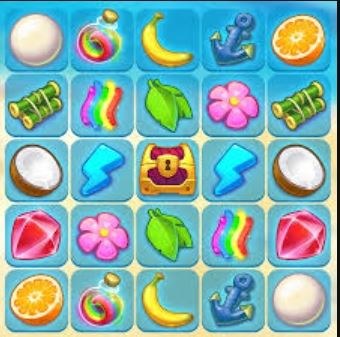
Onet Paradise is a clean, timer-driven connect-two puzzle where you clear tile pairs linked by an unobstructed path with no more than two turns. It suits players who want a fast, no-frills mental warm-up for short breaks, rewarding quick scanning and smart use of limited shuffles and hints. Skip it if you need progression systems or a relaxed, meditative experience, as the quiet countdown and occasional unfair boards create light, persistent pressure.
First Minute: Match, Blink, Repeat
I opened Onet Paradise expecting another lazy match-two clone. Ten seconds in, I was still expecting that. Then the timer kicked in, and I realized this game wants you slightly stressed. The first board looks generous — tiles spread across a clean grid, cute icons, nothing intimidating. You tap one, then another, and if they match and have a clear connecting path within two turns, they vanish. Simple enough. But by the 45-second mark, I’d already burned half my available shuffles and was staring at a board full of lonely tiles with no legal connections left. That’s the real tutorial: the game doesn’t hold your hand, it just lets you fail fast so you understand why you failed.
Visually, it’s unremarkable in the best way. No particle explosions, no mascot cheering you on, no forced ad after every level. Just a clean board, a countdown, and that quiet pressure that builds as you scan for pairs. The sound design is minimal — a soft pop when tiles clear, a gentle chime when you finish a board. It fades into background noise quickly, which matters if you’re playing while half-watching something else. I appreciated that the timer doesn’t scream at you until the last ten seconds. It just ticks down in the corner, letting you decide when to panic.
The Loop: Speed, Pathing, and the Shuffle Crutch
Onet Paradise follows the classic connect-two formula you’ve probably seen in dozens of free browser games. You get a board of tiles, each with a symbol. Your job is to clear all tiles by finding matching pairs connected by a path that has no more than two right-angle turns. The path must be unobstructed — no jumping over other tiles. When you clear the board, you move to the next level. The timer counts down from a few minutes, and if it hits zero, you lose. That’s the whole structure. There’s no story, no progression gimmick, no currency system I could find. Just level after level of increasingly dense tile arrangements.
What you’re really optimizing for is speed and board awareness. Early levels let you play lazily, picking off obvious pairs along the edges. By level five or six, the tile count creeps up and the layout gets more tangled. You start needing to think two or three matches ahead, because clearing the wrong pair can split the board into unreachable islands. The game gives you a limited number of shuffles — I started with three — and a hint button that highlights one valid match. Both are finite resources that don’t replenish between levels, at least not in the version I played. This means every shuffle or hint you use in level three is one you won’t have in level eight when the board is genuinely cruel.
I found myself developing a scanning rhythm: check corners first, then edges, then the interior. Corner tiles are often the hardest to connect because they have fewer approach angles, so clearing them early when you have options prevents late-game deadlocks. The interior tiles are easier to connect but riskier to leave for last because they can block paths to everything else. This tension between clearing what’s easy and clearing what’s strategically important is the core of the game. It’s not deep, but it’s enough to keep your brain lightly engaged without demanding full attention.
What Kills Your Run (And How to Avoid It)
My first three runs all ended the same way: I used a shuffle too early because I got impatient, then hit a genuinely unsolvable board state and had nothing left. The biggest mistake is treating shuffles like a convenience button rather than an emergency tool. If you can still see at least two or three valid matches on the board, do not shuffle. Scan harder. The pairs are probably there, hiding in plain sight because you’ve been staring at the same area too long. Look away from the center, check the edges, and specifically hunt for tiles that only have one possible match location. Those are your priority clears.
Another run-ender: clearing isolated pairs without considering what they’ll expose. I had a board where I gleefully matched two tiles in the middle, only to realize I’d disconnected a cluster of four tiles from the rest of the board entirely. No path could reach them without crossing empty space. The game doesn’t warn you when you’ve created an unsolvable layout. It just lets you keep playing until the timer runs out or you notice the problem. This is frustrating in the moment but honestly fair — it’s the core skill check. You need to visualize how the board changes after each match.
Timer management is the third common failure point. The countdown is generous on early levels but tightens as boards get larger. I caught myself spending fifteen seconds hunting for a single pair while the clock bled out. The fix is counterintuitive: if you can’t find a match in under ten seconds, use the hint. Yes, hints are limited, but losing a level because you hoarded hints is worse than using one to keep momentum. The game rewards fast, confident play more than perfect optimization. A mediocre match now beats a perfect match thirty seconds later when you’re panicking.
Phone vs Desktop: Where This Game Actually Belongs
I played Onet Paradise on both my phone and a desktop browser, and the difference is noticeable. On desktop, the larger screen makes scanning for paths easier, especially on later levels where tiles are smaller and more numerous. The mouse click is precise — you’re never going to fat-finger the wrong tile. But the game feels almost too stationary on a big monitor. It’s a small, contained experience blown up to a size that doesn’t suit it.
On mobile, it clicks. The touch controls are exactly what you’d expect: tap to select, tap to match. The game runs smoothly in a mobile browser with no lag between inputs, which isn’t always a given with free HTML5 games. The vertical orientation fits naturally in one hand, and the timer pressure pairs well with the kind of distracted, bite-sized play sessions that happen on a phone. I played most of my sessions while waiting for coffee or during short breaks, and that’s clearly the intended use case. One annoyance: on smaller phone screens, some tile icons got a little fuzzy, and I occasionally misidentified symbols. It wasn’t game-breaking, but it cost me a few seconds here and there.
There’s no app to download, no account to create. You open the page and play. That frictionlessness is the game’s best feature, and it works equally well on both platforms even if mobile feels more natural. If you’re someone who hates installing things just to kill ten minutes, this is built for you.
Who Should Play Onet Paradise (And Who Should Skip It)
This game suits people who want something between a fidget toy and a puzzle. It’s not demanding enough to replace a dedicated puzzle game like a nonogram or sudoku app, but it’s more engaging than mindlessly scrolling social media. If you have short gaps in your day — five minutes here, ten minutes there — and you want a game that starts instantly and doesn’t punish you for stopping mid-level, Onet Paradise fits. The timer pauses when you switch tabs or lock your phone, at least in my testing, so you’re never losing progress to a real-world interruption.
It’s also a good match for people who enjoy pattern-matching and spatial reasoning but don’t want to learn complex rules. There’s no tutorial to sit through, no upgrade tree to decipher, no energy system that limits how much you can play. You understand the entire game within thirty seconds of starting. That’s rare and valuable in the free browser game space, where too many titles front-load mechanics to hide shallow gameplay.
On the flip side, if you need progression systems to stay interested — levels to unlock, scores to beat, cosmetics to earn — Onet Paradise will feel empty. There’s no meta-game. You clear boards and move to the next one, and the only thing changing is the tile layout. No achievements popped up during my sessions, no leaderboard, no way to track how far you’ve gotten besides remembering the level number. For some players, that’s liberating. For others, it’s a reason to quit after fifteen minutes and never come back.
People who get easily frustrated by time pressure should also approach with caution. The timer isn’t brutal, but it’s always there, and some boards feel genuinely unfair when the tile arrangement leaves you with one obscure pair while seconds drain away. If you want a relaxed, meditative puzzle experience, this isn’t it. Try a jigsaw game or a slow-paced match-three instead. Onet Paradise is a light stress machine disguised as a casual game, and you need to be okay with occasionally losing to a board that simply didn’t cooperate.
A Practical 10-Minute Practice Plan
If you want to get competent quickly — not mastery, just consistent enough to enjoy yourself — here’s a focused ten-minute session that helped me stop dying on level four.
First two minutes: ignore the timer entirely. Open a level and just scan the board without making any moves. Look for corner tiles and edge tiles specifically. Count how many of each symbol you see. If a symbol appears only once, that’s a visual glitch or you’re misreading it — every tile has a pair. Practice identifying which tiles have only one possible connection route. Those are your bottlenecks. Do this on two different boards without touching anything.
Next three minutes: play a level at normal speed but narrate your choices out loud. Say “matching these two opens a path to that corner” or “if I clear this, I trap those three.” The narration forces you to think about consequences instead of reacting to whatever pair you spot first. You’ll play slower, and you might time out. That’s fine. The goal is to build the habit of scanning for second-order effects.
Next four minutes: play two levels where you deliberately save your shuffles and hints. Don’t use them even if you’re stuck. If you can’t find a match, let the timer run out. This teaches you to trust your scanning ability and reveals how often you were using shuffles out of impatience rather than necessity. After two forced timeouts, you’ll start noticing pairs you previously missed.
Final minute: play one more level with everything you have. Use hints when you need them, shuffle when the board is truly dead, and play at whatever speed feels natural. Compare how far you get versus your earlier runs. In my case, I cleared two more levels than usual because I’d stopped panic-shuffling and started trusting that most boards are solvable if you look long enough.
This isn’t a game that requires deep practice, but ten minutes of focused attention upfront saves a lot of frustration later. The skills transfer between levels since the mechanics never change — only the board layouts get more ornery. Once you’ve internalized the scanning patterns and learned to hold your shuffles, Onet Paradise becomes exactly what it wants to be: a quick, satisfying palate cleanser between the more demanding parts of your day.