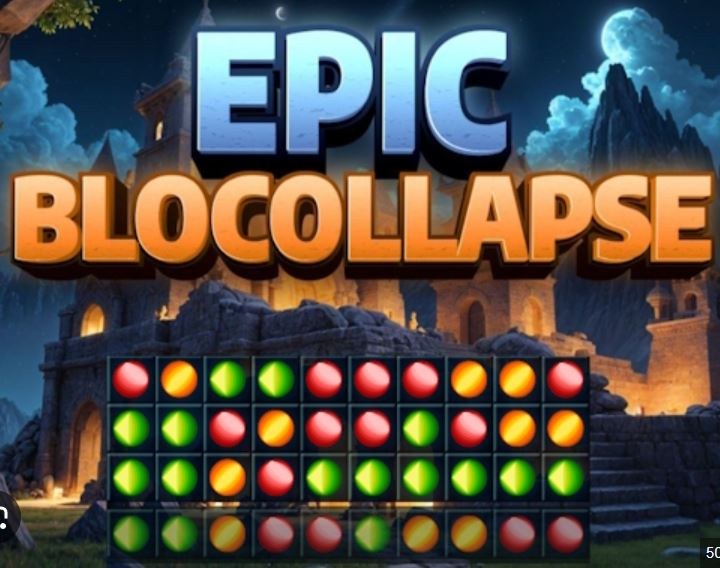
Epic Blocollapse is a strategic block-clearing puzzle where you remove same-colored groups from a static grid, aiming to leave as few isolated blocks behind as possible. It suits patient, planning-oriented players who enjoy spatial puzzles without time pressure, but not those who crave constant action or new mechanics.
First Minute: A Wall of Color and That One Annoying Block
You open Epic Blocollapse and you're staring at a grid packed with colorful blocks. No tutorial, no hand-holding — just a wall of squares and a cursor waiting for you to click. The first thing I noticed was how satisfying the collapse feels. You click a connected group of same-colored blocks, they vanish with a little pop, and everything above slides down. That first minute is almost meditative. Then you realize the board isn't refilling. You're not just clearing for points; you're trying to leave as few blocks behind as possible. By the 45-second mark I had already stranded three single blocks in corners and felt that familiar pang of "well, I messed this up."
The Loop Isn't About Speed — It's About Leaving Nothing Behind
Unlike match-three games where new pieces fall in to keep the chaos going, Epic Blocollapse gives you a static board. Your job is to remove groups of two or more adjacent blocks of the same color. The bigger the group, the more points you get. But the real optimization isn't the score ticker at the top — it's the cleanup. Every block you can't match because it's isolated becomes a penalty. The game grades you at the end based on how many stragglers you left. I found myself ignoring juicy 8-block groups early on because taking them would orphan a pair of blues on the left side. You start thinking three moves ahead, which is more strategic than the bubbly graphics let on.
There's a bomb power-up that shows up occasionally. You click it and it clears a radius around it. I hoarded these. Using a bomb on a cluster that's already easy to clear feels wasteful. The smart play is saving them for those stubborn solo blocks you know you'll create later. The tension sits between immediate gratification and delayed rescue.
What Actually Ends Your Run Early
I lost on level 4 three times before I figured out where I was going wrong. Here's what kept tripping me up:
- Clearing the biggest group first without scanning the edges. The center looks tempting, but the blocks hugging the borders are harder to match later when their neighbors are gone. I started scanning the perimeter before touching anything in the middle.
- Ignoring small color minorities. If there are only three orange blocks on the whole board and two are touching, you need to grab that pair immediately. Wait and one of them gets isolated, and now you've got a permanent penalty. I treated rare colors like endangered species.
- Popping bombs to "see what happens." The blast radius is generous but unpredictable if you haven't mapped what's adjacent. I once blew a hole through a cluster I was saving and stranded four blocks in one click. Felt like an idiot.
- Forgetting that columns collapse vertically. After a removal, blocks drop straight down. If you clear a group on the right side, the blocks above it fall and might connect with something you were planning to use later. I started clearing from top to bottom when possible to control the drop patterns.
How It Feels on Phone vs Desktop
I played on both. On desktop, the mouse is precise and you can hover over groups to see how many blocks are connected before committing. That little preview is generous and I relied on it heavily. On a phone, your finger covers the block you're tapping, so you're guessing more. The touch targets are big enough — I didn't mis-tap often — but you lose that information advantage. I preferred desktop for the harder levels where planning mattered. Phone felt fine for quick, casual runs where I wasn't obsessing over a perfect clear.
One thing: there's no undo button. On either platform. You click, it's gone. I wanted one badly around level 6 when I accidentally tapped a group I was saving. If you have shaky hands or are playing on a bumpy commute, expect a few rage-inducing misclicks.
Who Should Actually Play This
If you like puzzles where the challenge isn't time pressure but spatial planning, Epic Blocollapse scratches that itch. It reminded me of those wooden block removal puzzles where one wrong pull collapses the structure, except here the punishment is just a bad score and a lingering sense that you could have done better. Perfectionists will replay levels to get zero remaining blocks. I did that for level 2 and it took four attempts. Satisfying when it clicked.
People who enjoy clearing mechanics like in Threes or even the old SameGame will find the DNA familiar. It's a good second-screen game — something to poke at while listening to a podcast or waiting for a download. There's no timer, no enemies, no lose condition beyond your own standards.
You should skip this if you need constant feedback or escalating action. The game is quiet. Even the music is understated. If you get bored without new mechanics being thrown at you every few minutes, the loop will feel repetitive by level 10 or so. The core challenge doesn't change much — just the board layouts get trickier. It's also not a good fit if you hate restarting. Some boards feel unwinnable for a perfect clear depending on your first three moves, and you won't know until the end.
A 10-Minute Practice Plan That Actually Helps
I spent a few sessions trying to get better deliberately instead of just clicking around. Here's a routine that tightened up my play:
Minutes 1-3: Pick level 1 and don't touch anything for the first 30 seconds. Just scan. Identify every isolated block that already exists before your first move. Then find the smallest color group on the board. Your first click should be that group, not the biggest one. Do this twice. The goal isn't score — it's training your eye to see vulnerability before action.
Minutes 4-6: Move to level 3 or 4. Play one full round where you only clear groups of exactly two blocks. No threes, no fours. This forces you to think about how each removal reshapes the board. You'll probably leave a mess, but you'll start to feel how small actions cascade. After that round, play the same level normally and notice how much more control you have.
Minutes 7-9: Pick any mid-game level and play it twice. On the first run, use your bomb as soon as you get it. On the second run, save it until you have fewer than five moves left. Compare the end screens. For me, the delayed bomb almost always resulted in fewer leftover blocks. This taught me patience with the power-up.
Minute 10: Play one level with the sound on and no other distractions. The audio cues when groups are selected are subtle but helpful — you get a different tone for large groups versus pairs. I started using that feedback to confirm my selections without looking at the number counter.
After ten minutes of this, I was reading boards faster and making fewer dumb mistakes. Not a magic fix, but the deliberate reps helped more than grinding levels mindlessly.
A Few Things I Noticed After Longer Play
Around level 12, the boards start introducing more colors. That sounds obvious, but it changes the math completely. With four colors, you can usually clear everything if you're careful. With six or seven, some blocks are destined to be orphaned no matter what. The game shifts from "can I get a perfect clear" to "can I minimize damage." I had to recalibrate my expectations there. Chasing zero on those later levels felt like gambling, not planning.
Also, the score multiplier for large groups is exponential-ish. A group of 12 gives way more than twice the points of a group of 6. But chasing those mega-groups often strands smaller clusters. I found the score system slightly at odds with the cleanup goal. You have to decide early in each level whether you're playing for points or for a clean board. I couldn't do both consistently.
The game runs fine in a browser. No lag, no ads between every level — I got one banner ad at the bottom that didn't interrupt anything. It loaded quickly and didn't heat up my phone. For a free HTML5 game, the presentation is polished enough that I forgot I was in a browser tab.
Epic Blocollapse won't change your life, but it's a solid 15-minute diversion that rewards a little brainpower. I'll probably keep it bookmarked for coffee breaks. Just don't expect fireworks — expect a quiet puzzle that punishes greed and rewards someone who thinks two steps ahead.