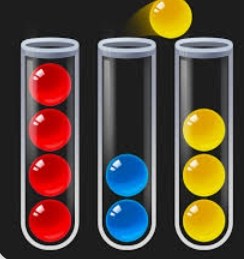
Ball Sort Puzzle is a pure spatial logic toy where you sort colored balls into matching tubes with no timer or score pressure. It suits players who enjoy meditative tidying puzzles and want to train foresight and working memory, but offers no story or hints. Skip it if you need narrative stakes or get frustrated by games that don’t explain their deeper strategies.
You open Ball Sort Puzzle and it's almost too calm. A handful of glass tubes sit on a flat pastel background, each holding three to five colored balls stacked in messy layers. No timer pulses at you, no score counter ticks upward. The first move feels obvious: tap a tube, then tap another, and the top ball slides over if the color matches and there's room. In that first minute you're just pushing balls around, clearing a tube here, accidentally blocking yourself there, and the gentle click sound makes the whole thing feel like a desk toy you can't put down.
The loop that gets its hooks in
You're not racing anything except your own last attempt. Each puzzle presents the same basic challenge: sort every ball so each tube holds only one color. New tubes appear empty, waiting for you to use them as workspace. The difficulty doesn't come from the rules — those stay dead simple — but from the spatial crunch. You have limited empty tubes, sometimes only two, and every move you make either opens up the board or paints you into a corner.
What you end up optimizing for isn't speed. It's move economy and foresight. I found myself staring at a half-solved board for thirty seconds, mentally tracing three moves ahead, because one wrong tap would bury a needed color under two layers of stuff I couldn't shift yet. The game rewards the same part of your brain that enjoys untangling Christmas lights. There's no undo button in most versions, which sounds harsh but actually makes you care about each decision. When you do get an undo, it's limited, and burning one feels like admitting you weren't paying attention.
Where things go sideways
After maybe twenty puzzles, patterns emerge in the ways you fail. The most common trap I hit was premature consolidation. You spot a tube with three matching balls on top and immediately start feeding that color, feeling productive. But now that tube is full, and the bottom ball is a different color you trapped there twenty moves ago. That color is now locked until you empty the whole tube, which you can't do because its matching balls are scattered across three other tubes that are also half-sorted. You've created a gridlock that only an empty tube can solve, and you already filled your empties.
Another killer: ignoring the bottom layer. Early puzzles let you get away with just reacting to whatever color is on top. Around level 40 or 50, the game stops being polite. You'll have tubes where the top ball is red, but underneath sit two blues and a green. If you treat that tube as "the red tube" and start piling reds in, you're building a prison for those blues. I started physically saying "what's underneath?" out loud before committing to a stacking sequence, and my completion rate jumped noticeably.
The third mistake is empty tube hoarding. New players treat empty tubes like a precious resource and refuse to use them for temporary storage. But an empty tube sitting unused is just dead space. The advanced habit is treating empties as active sorting tools: drop a color there for two moves while you rearrange what's underneath, then pull it right back out. Empties are meant to be cycled through, not preserved like a health potion you never drink.
Phone versus desktop: it actually matters
I played on both. The phone version, which is how most people encounter this game, has a particular friction: your thumb covers the tube you're about to tap. On a five-inch screen, the tubes sit close together, and I mis-tapped more times than I'd like to admit, especially when trying to move quickly. The fix isn't to slow down — it's to hold the phone differently. I started using my index finger for precise moves on trickier puzzles, which felt ridiculous at first but cut my error rate to nearly zero.
On desktop, the mouse gives you pixel-perfect accuracy, and you can see the whole board without your hand obscuring anything. The trade-off is that clicking feels less immediate than tapping, and I found myself playing more slowly, almost overthinking. Neither version is strictly better, but if you're grinding the harder levels, desktop wins for pure accuracy. If you're playing to unwind during a commute, phone is the way, just budget for the occasional fat-finger restart.
Who this game is actually for
Ball Sort Puzzle isn't for everyone, and that's fine. If you need narrative stakes, character progression, or any kind of payoff beyond the quiet satisfaction of a perfectly sorted board, you'll bounce off within ten minutes. There's no story, no unlockable skins that change gameplay, no boss fight at level 100. It's a pure spatial logic toy.
You'll like it if you enjoy puzzles that feel like tidying up — think organizing a bookshelf by color or decanting bulk ingredients into matching jars. There's a meditative quality to the repetition, but it's not mindless. The game asks for genuine concentration once the tube count increases. I'd also recommend it to anyone trying to build a low-stakes focus habit. Because there's no timer and no penalty for sitting still, it's weirdly good for training yourself to pause before acting.
Skip it if you get frustrated by games that don't explain their deeper strategies. The tutorial covers tapping and matching, then drops you. No tooltips, no hint system in most versions, no gentle nudge when you've been stuck for five minutes. You either develop the advanced habits yourself or you hit a wall and quit. I respect that austerity, but it's not universally charming.
A practical 10-minute practice plan
If you're past the basics but keep stalling around the same level range, here's a focused drill that helped me break through. Set aside ten minutes and treat it like deliberate practice, not casual play.
First two minutes: open any mid-difficulty puzzle you've already beaten. Don't solve it from memory. Instead, scan every tube and identify the bottom ball color in each. Say the colors out loud or write them down. This forces you to build the habit of seeing the hidden layers, which is the single skill that separates the stuck from the progressing.
Next three minutes: solve that same puzzle while following one strict rule — you cannot fill any tube beyond three balls of the same color unless you've already verified the ball underneath matches. Break the rule, restart. This feels slow and pedantic, but it rewires the premature consolidation impulse.
Next three minutes: take a fresh puzzle at your current difficulty wall. Before your first move, find the color that appears most frequently across all tubes. That's your anchor color. Plan to dedicate one empty tube to it for the entire solve, but only after you've cleared at least two other colors completely. The drill here is sequencing: dominant color last, not first.
Final two minutes: play normally, no rules, but narrate your reasoning in short phrases. "Moving green to empty so I can free the purple underneath." Vocalizing makes sloppy thinking immediately obvious. You'll catch yourself mid-sentence realizing the move doesn't actually achieve what you thought it did.
Do this three times a week and the habits start to stick without the narration crutch. The game doesn't change — your pattern recognition does.
The quiet depth nobody talks about
What kept me playing past the point where many would uninstall is how the game teaches you to hold multiple incomplete sequences in your head simultaneously. By level 70 or 80, you're maintaining three or four partial color stacks across different tubes, each at different stages of completion, while tracking which empties are temporarily occupied and which colors still need extraction from the bottom of nearly-full tubes. It's working memory training disguised as a phone game.
There's also a subtle shift in how you perceive the board over time. Early on, you see individual balls. After enough hours, you start seeing tubes as states: "this one is red-ready but blue-blocked," "this one is a dump tube I can cycle." The board stops being a collection of objects and becomes a set of constraints and affordances. When that clicks, the game opens up. Puzzles that seemed impossible now feel like they have a clear, if narrow, path through.
Just don't expect fanfare when you finish a tough level. The game gives you the next puzzle and the same quiet background. That's the whole deal. If you need a parade, look elsewhere. If you want to get genuinely good at something small and self-contained, Ball Sort Puzzle will take you as far as you're willing to push.